Showing posts with label brass. Show all posts

Wednesday, January 7, 2015

Jewelry trends for spring 2015


Carol Dekle-Foss

Hello everyone! I took a few weeks to relax before the new year so I could refocus my intentions and gain clarity as to what I wanted to accomplish in 2015. It was good for my soul, so now I'm fired up for the new year!  I've hit the ground running...literally.  With my Fitbit snugly on my wrist I've managed to avoid the holiday weight gain by working out almost everyday. 

So keeping healthy is one goal I have for 2015, but I am also working on jewelry pieces for magazine submissions, craft fair and festival applications, and revamping my website. In a few weeks it's back to school where I will be continuing to learn French. Also, My father has recently been diagnosed with Alzheimer's so a lot of my time will be spent taking care of him. It should prove to be a very busy year, but I am determined to make it the best yet!!!

I recently took a peek at the latest jewelry trends for spring 2015. I should say I never follow trends but some of these have roused my creative juices! 

Here are a few of them that have piqued my interest:

Chunky necklaces

Staci Louise Smith nails this look with her bold and dramatic necklaces. I love how she is able to create such perfect asymmetry.


Irregular Earrings 


Earrings that are irregular and unbalanced. I love these earrings by Kelli Pope for their deep sweeping curves and a pop of black beads placed in just the right spot.
Chokers


Chokers in a variety of shapes, styles and gems. I've always loved chokers so this look has me really excited! After reading about the new trends, I immediately headed to the studio to create this necklace

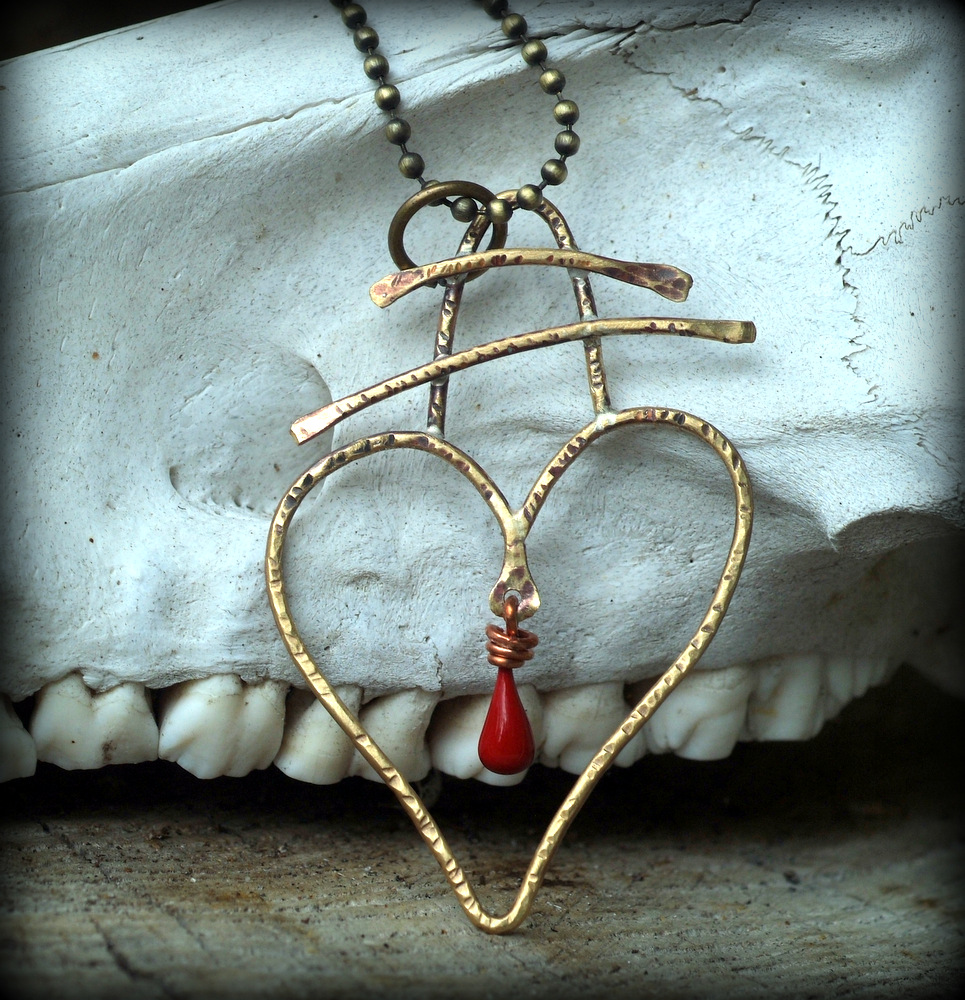
Brass metal


Bold statements in brass. Karen McGovern created this beautiful brass wire heart pendant with a cute little red enameled drop. 

Boho with a modern twist


Boho meets deco. Barbara Bechtel made these lovely star and crystal boho earrings that have a rustic and linear look.    

So those are some of my favorite trends for this year! What about you? Do you keep up to date on the latest trends or completely ignore them? Do tell!

Monday, June 30, 2014

"Marriage of Metals" technique & tutorial

Carol Dekle-Foss
I learned this cool technique a couple months ago in my intermediate metalsmith class. I just LOVE it! I have always been attracted to geometric patterns and also mixing different metals. This technique was perfect for me to explore in my jewelry designs. These earrings are my latest creation, and for my first Boot Camp post, I'm going to show the readers of LMAJ how I made them. Tools & Materials on the bottom of the page.

Step one
Create the shapes you want on a computer software program such as Photoshop and print on regular paper.

Step two
Select your sheet metals, making sure they are all the same gauge. For the earrings I used sterling silver, copper and brass.

Step three
With a triangle, sharpie and a ruler, mark your shapes on the metal using the printout as a guide. Make sure your lines are a bit larger due to loss when cutting out and sanding. You will only need the basic geometric shapes for now.

Step four

 Cut out the sheet metal. I prefer a metal shear for the most accurate cuts. Here is my throatless shear from harbor freight. It's great for cutting accurate lines, and saves me tons of time in the studio.
Step five
Place sandpaper on a flat surface and run metal edges over it lightly to remove burs and even out the metals edges. 
Step six

Place metal pieces on flat surface and line up making sure every piece touches with no gaps for best results. Also for earrings, position pieces to form a mirror image.

Next, flux and then with the flux brush pick up solder pieces and place where joins meet. In the pic below you can see the solder pieces positioned. I cut them in thin rectangle shapes to try and prevent solder from flowing all over the metal, and hopefully to only go in the cracks of the joins. Keep in mind, solder flows wherever the heck it wants too anyway.

Step seven
Solder the pieces with a fairly large flame. Copper and brass have a higher melting temperature so you want to focus your flame on those pieces and avoid the sterling silver so you don't melt it. I use the Smith torch purchased from Cyberweld. This is where my teacher referred me to purchase mine in case you are in the market for one. NOTE: Soldering is a technique you have to practice to master. It takes time and patience, so don't be too hard on yourself if you are having difficulty. I know I struggled for a long time. If you want to learn I recommend taking a metalsmith class, or find a mentor to teach you the basics. If you have specific questions feel free to contact me and I will try to help! Also if you haven't discovered Nancy Hamilton you are in for a treat! She is so much fun to learn from. Here is a youtube video from her on soldering basics.

Here is the front of the pieces after pickling. You can see the solder flowed through in some areas. The back is a hot mess, as you can see in the below pics.
Step eight
Place paper shape onto metal and mark with sharpie. Then cut out with jewelers saw.

Step nine
 Sand edges with a belt sander or a bastard file.
Here is my sander from Harbor Freight. Again, a major time saver, and you can't beat the price. I hate filing and will avoid it at all costs.

Next, place the piece on top of the other and line up. Mark with sharpie and then saw out with jewelers saw.
Final finishing techniques
Ok, here are the two pieces. One is the front, and one the back. Yucky solder flow right? The next steps are all finishing techniques. So for my next post, which is scheduled for this Wednesday, I will show how I got the pieces to look like the above earrings! Plus some awesome techniques to speed up your finishing.

Here are some other designs utilizing the above technique.

My first pair of earrings finished in class.


For this necklace I used a lentil bead from Heather Powers of Humblebeads. I fell in love when I first saw it! 
 She was inspired by the Vincent Van Gogh Sunflower painting below. 
I used the "marriage of metals" technique and combined brass and bronze to form the vase. I then soldered it to a solid copper backing.

I love this technique and feel the design options are endless. So what do you think? Is it something that you might want to try? I would love to hear your thoughts!

TOOLS & MATERIALS
Torch                                                            
pickle pot
solder, medium
flux
different sheet metals
geometric shapes on paper
sandpaper, various grits
permanent sharpie, fine tip
jewelers saw
Photoshop or similiar program
paper
Sheet metals
triangle
metal ruler
sander or bastard file
metal shear
flat soldering surface
safety goggles
dust mask

Thursday, April 25, 2013

Always Evolving


by Staci Smith


Well- I am in show prep mode once again, but this time it's jewelry shows!  Each year to try to find a new direction to go in, just a little bit.  I have been very drawn to ancient, tribal, ethnic looking items lately.  So I wanted to add some brass to my jewelry line.  I have used it a little bit here and there, like in these Boho Hoop style earrings last year.

Brass Boho Hoops
 
I was never really a fan of gold, and yet, somehow, I am now being drawn to the richness of this golden yellow metal. 
 
Along with adding brass this year, I started to make some of my own chains for charm style necklaces.  Yesterday, I finally completed one, so I am sharing it with you, since it is all I have worked on for a couple days!!!!


I really like the results of both the chunky chain charm style and the richness of the brass.  I will certainly be making more!!!!  I think that the brass also begs for color to be added, and so, I am beginning to add more pops of color to my work.  Always evolving.  Not sure if its a process or just because I get bored easily!  Either way, it keeps things fresh.
 
What is your favorite metal to work with?
 
Is there a metal you have been wanting to try, but just haven't done it yet?

Saturday, March 23, 2013

What kind of Metal can I texture?

by Staci Smith

This was the first question I asked when buying my metal supplies.  I remember how shocking it was that you could use 24 gauge metal and it wasn't paper thin.  I was thinking in wire terms, and thought it would be frail and thin.  Now, the number gauges run in the same way wire does, smaller number, thicker gauge, but they certainly feel very different.
 
So I thought I'd give you a little information on metal sheet.
 
The most popular metals are sterling silver, copper and brass.  I highly recommend starting with copper.
 
Copper is softer then brass, and cheaper then sterling silver.  So it works easy, and if you make a mistake, it's not a devastating financial loss like it would be with sterling silver.


When you go to buy sheet metal, some places sell set cuts- like 3x6" or 6x12".  Others (like www.thunderbirdsupply.com) let you choose your own cut size.  This is handy to know depending on what you plan to do.
 
For example, at Thunderbird, you can order 10 pieces cut at 2x7.5" if you are planning to make cuffs (not sure what cuff standards is, I just picked that measurement at random)- they are pre-cut to the size you want.  They also have the option of set sizes.
 
Another thing to consider when ordering or buying sheet, is how you plan to cut it, and what you want to use it for.  26 gauge is very thin, very lightweight and easy to manipulate.  This is great for fold forming items that may be used in earrings.  I also use 24 gauge often for earring designs so they aren't too heavy. 
 
If you need something to be sturdy and unbendable under stress, you want to use a thicker gauge, 22-18 gauge.  Keep in mind how you plan to cut these sheets.  You can only use metal shears up to 22 gauge (usually).  So if you need thicker metal sheet, you will need to saw it.
 
I have ordered the standard large sheets of metal 6x12" and I found them too bulky to work with.  I don't have a quick way to cut them down, so it's been awkward to work with them, which I why I like to customize my sheet size.
 
I hope that helps with some questions you may have on buying sheet metal.  For a beginner, especially for our Metal texture Boot Camp, I highly recommend copper.  It cuts and stamps like butter!
 
We can't wait to see what you guys are working on.  Remember- the blog hop is April 8th.  On that day, you will be able to link up to our site.  Happy hammering.


Saturday, February 25, 2012

metal stamping

mary jane dodd


one of the first techniques i tried was metal stamping... 

how hard could it be? you have a metal blank and hit the metal punch with a hammer on an anvil or bench block... 

right?

well, yes... 

and, no... 

i learned that you could get some very frustrating results... 

like double striking - you know that one, where you get a double image of the stamp... 

or the letters are drifting up (or down)...

or the character is sideways - because you didn't check that one last time to make sure it was being held correctly in your hand... 

when you make mistakes in stamping, it can be incredibly frustrating - you can be almost to the end of a phrase and get careless... the metal gets put into the recycle bag... but if you aren't able to cut your own discs, you have now lost one blank in your limited supply... 


like any technique, it is worth learning about... trial and error are always important learning methods, but the waste of time and money can be teeth gritting... 

double strikes - if you are using a steel hammer to hit a steel punch on a steel bench block there is a lot of bounce back... the energy has to go somewhere... for me, a brass head hammer has really been helpful... a softer metal, brass absorbs the shock... 

brass head hammers are also recommended any time you are hitting something steel - like when using a disc cutter... metal work hardens when it is repeatedly struck... eventually it can snap... using the brass lessens that effect... 

wonky orientation - draw a line with a sharpie marker, double check just one more time that the stamp is facing the way you want it to...

and find the position that works best for you... meaning, whether you are sitting or standing depending upon how high your work table is... it matters in terms of the strike... i have found that i really do need my elbow to be able to come to a 90* angle...  stamping is also not really a technique you can do on a plastic card table... you need some stability behind it... 


i hope these tips will reduce some of the frustration for you... because there are such fun and beautiful stamps out there to purchase... and it is a rather inexpensive way to personalize your work... 

if you want to be inspired by clean stamping, take a look at the work of cindy pack - she is a great example of one who knows her tools and the techniques by which you optimize their use... 


if you want to dap your discs, use a wooden set...


a great source (besides etsy) is beaducation ... 
face
Related Posts Plugin for WordPress, Blogger...