Showing posts with label jewelry making. Show all posts

Friday, December 4, 2015

8 Tips to Improve Your Jewelry Making Skills

by Sherri Stokey

Perhaps I should clarify:  even though I've titled this piece 8 Tips to Improve Your Jewelry Making Skills, please don't stop reading if you don't make jewelry.  Most of these tips (if not all) can apply to other crafts as well.  Either way, I've put a lot of thought into this article and since you're already here anyway, you might as well finish reading it.  Plus it's good manners.  If you get to the end and feel I've wasted your time or you don't agree with me on one point or another, you can always leave a comment and give me a piece of your mind.  With that out of the way, let's get to the list.  


1.  Practice!  Although we all like to think we are the 1% who can pick up something and do it perfectly the first time, it just doesn't work that way.  If you ask your most admired artists, they will tell you that they've come a long way and devoted a lot of hours to perfecting their craft.  Which leads us to #2...


2.  Strive for perfection.   This one might not apply to every art equally, but in some mediums, like micro macrame, neatness counts.  It's all about keeping the knots even with the same tension, crisp corners and straight lines.  In other mediums it might be a matter of getting a smooth solder or a perfectly coiled wire.  Mediocre isn't good enough - strive to do the best work you can.  You won't get this one without #1 (practice).  Fact.


3.  Play!  #1 and #2 make it sound like making jewelry is drudgery and it couldn't be further from the truth.  Allow yourself time to play around in whatever way is fun for you.  Sometimes I like to goof around with random knotting just to see what develops and sometimes I like to try the strangest color combination I can dream up.  Just for fun.


4.  Take a class.  I had never been able to take a class until last year, and I thought I'd done okay for myself with the self-teaching bit.  And I had.  But when I had a chance to take a class I was really excited by the whole experience.  There's just no substitute for learning from someone who really knows what he or she is doing.  I picked up some great tips and got a fresh infusion of enthusiasm for possibilities I hadn't considered.  


Even if you live in the middle of nowhere like me, with no access to local bead shops or experts, there are online classes available. Although a live class is nice so you can interact with the instructor and other students, online classes have some strong points of their own: you can pause them, replay portions and tailor the experience to your own schedule without disrupting other students.  Whether live or recorded, classes offer you an opportunity to grow and develop your skills.


5.  Network.  Find a local group of like-minded enthusiasts or join an online community.  It's fun!  I belong to several groups on Facebook and I really enjoy them.  I love to see the different styles of  artists from all over the world. Plus, having a group of friends who have the same interests can be helpful if you get stuck.  Usually there's someone  who has faced the same issue you're experiencing , or at least someone who can offer some creative solutions.  It's also a great way to find inspiration, which leads to #6...
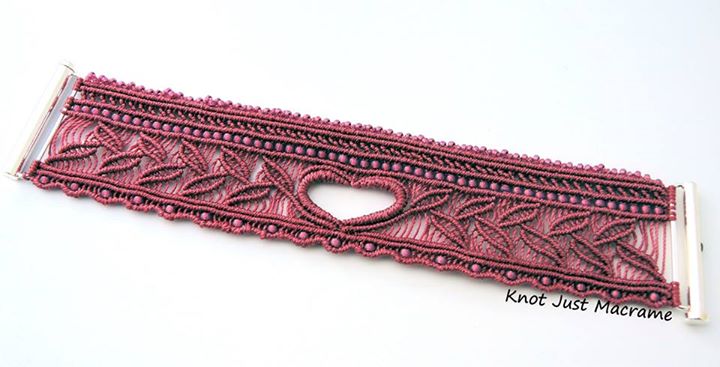

6.  Look for inspiration.  Whether you find inspiration by taking a stroll through the park or a hike in the mountains or a trip to the zoo, or something more sedentary like scouring the Internet, inspiration is there and free for the taking.  Clear your mind and take a fresh look at everyday objects.  Think in terms of texture or color or lines, then try to replicate even one part of that in the medium of your choice.


7.  Experiment.  Don't be afraid to fail.  Try something different - if you usually work with polymer clay, try your hand at micro macrame.  If you are a knotter, pick up a bead weaving tutorial and give it a go.  Try torch fired enameling (make sure the blinds are out of the way first and don't ask me how I know that).  The point is to step outside your comfort zone, color outside the lines.  Sometimes when you do that, it blurs where you thought your boundaries were and opens the door to some amazing things!


8.  Find your style.   It has taken me a long time to put my finger on what makes one piece fantastic and another mediocre, even when the two are very similar and I've finally boiled it down to one thing:  authenticity.  The whole point of art is to express yourself.  It's great to learn from a class or follow someone's pattern, but in the end, you need to find a way to make it yours if you want to take your art to the next level.  Find your voice and then sing like nobody's listening (cliche, cliche, cliche - but accurate).  Do you like no one else can!


Thursday, September 3, 2015

Artist Beads and Earrings - Learning the Jewelry Basics

Sometimes in life, things work out in ways that you feel pretty fortunate.
Like having the opportunity to spend a good portion of my 30's making beads and traveling around the U.S. to sell them (before the internet took over).
Marsha Neal Studio and Thornburg Bead Studio Artist Bead Earrings
While traveling, meeting SO many wonderful bead makers, jewelry designers, jewelry hobbyists (which a lot of those people had serious jobs, and dabbling with jewelry making was their relaxation and they did not want it to be another job).

 Growing up I never dreamed of making beads or jewelry, but I always dabbled.
Here is a bad photo of a back shelf where I have all of my beads purchased at big craft stores, as I grew up. There are also some beads in there from when I first discovered the bead shows in my area. I quite remember getting sold "silver" beads, but the silver plating coming off over time, then the vendor - the next time the show came around - denied that they were his beads (he had more of the exact bead strand on the table - what a jerk taking advantage of a new beader!)


We all have to start dabbling somewhere. Sometimes the easy and cheap is the way we go.
And that is great when you are experimenting, or can use the product in ways that are very creative.
But your work goes to the next level (in my opinion) when you start to really understand your materials, and can start to design with them to have a great look, a good wearable feel - if that is your goal, and will hold up over time with intended wear.


I work part time at a wool shop and art house in Elkton, MD called Sarafina Art House.
It has been a blessing for me to have a job outside of the house around inspiring people and creative energy. We all bring a little something extra to the table creatively, and when it comes to classes, I tend to lean to the basic jewelry side of things.

The above photo is a quick shot of some of the materials I am going to bring with me to a series of classes I am going to teach in October "Earrings in an Hour". I am going to go over some of the basics of jewelry making: tools, supplies, techniques, design and inspirations. Each person is going to be able to make up to two pairs of earrings that night to take home, and I am going to be doing this for three weeks straight - with two different designs each week!


I really wanted to help people understand some different things about materials so they can start to find their creative way with jewelry making.

What are some fun tips you would share if you were teaching a beginners wire working class?
I may print some of these off with your name of course and let them read them in their take home.

PS - I have a ton of things in my head already, so asking for "tips" is just to make sure I don't forget anything important - which can happen frequently once you get comfortable with your wire work.

Thursday, June 7, 2012

guest post - susan of libellula jewelry


I’d like to talk about “style” and whether or not our work is perceived as having a “cohesive style”.  I’ve been told that in order to create a brand and have my work be recognized or known, that I must settle upon a style and make my work more centered and cohesive.


At first, I tried to decide exactly what my style is or isn’t and it quickly became obvious that I could not limit myself or box my creativity into one style.  I remember reading Lori Anderson’s blog posts about her eclectic style in both her home decoration and jewelry design.  It has not held her back.


It reminds me of an acquaintance in New Orleans.  Shamarr Allen is a trumpeter, singer, and songwriter who started out learning the Jazz standards.  He became not just good but very, very good and the old guard Jazz musicians wanted him to stick with only Jazz.  They didn’t like that he was young and wanted to branch out into Hip Hop or Rock-infused music.  That led to him recording a cd titled Box Who
In?  He went on to record and tour with Willie Nelson and Asleep At the Wheel and got some experience playing Country Swing.  He has since said that he will record any kind of music he wants and that he might even record a Country cd. He might be joking--or not.


So, I’m going to listen to my heart and follow my ideas wherever they might wander.  I may never have a body of work that is distinctly recognizable as my “style” but I will have been true to what I enjoy making.  And just in case, I’ll keep putting my little tags on my jewelry.  Maybe that will help people know it’s my
work!
...................................................................................

you can find susan a.k.a. libellula jewelry here:

blog

etsy shop - cicada silver

etsy shop - libellula

flickr 


Saturday, May 12, 2012

trying out a tumbler

mary jane dodd

this is a tumbler that a friend lent to me... it can be found at target, toy r us and of course - amazon... i have not been using it long, and in fact, don't know if this particular model is the one that will best suit my needs... it serves as an example only... 

it is one of those big additions - and i am not referring to cost here - and what it does is pretty important and helpful... 

tumblers will harden metal components - ear wires, clasps, etc. - and remove sharp edges... adding another level of professionalism to your work... it will save you time... if i had to rank it in terms of my other tool/investments, it would be pretty high (and make me wonder why i hadn't tried it before... oh right, i know - that resistance we have to new things as much as we are intrigued by them...)

an excellent post on tumblers can be found here... 


Tuesday, April 12, 2011

On my to do list...

are a million things, and I'm feeling overwhelmed. I'm not even going to mention the To Do's associated with the Feathered Ones, who will be moving out of the house and into their own place in another day or so. I'll share my list with you if you'll share yours with me. Maybe then they won't feel so ominous?

Here's mine, in no particular order, reflecting the state of my poor brain right now.

1. Finish something, anything with seed beads!
2. Get back on the torch and complete my custom orders.
3. Finish taxes.
4. Figure out an inventory system that is more tax friendly (* I think I have an idea, to be shared soon).
5. Fix my friend's broken earring without melting it to pieces.
6. Finish a meanie ring for another friend's Christmas present (yeah, this is pretty bad, huh?).
7. Finish my Riverbed cuff from Kate's book (need to wire wrap lots of components).
8. Plant my potato tower.
9. Address the green moss invading the surfaces in our outdoor living areas, and the wood that has succumbed to dry rot.
10. Finalize summer travel plans.
11. Get cucumber and bean seeds in the ground.
12. Rework several pieces I'm not happy with.
13. Get more work photographed and listed in my Etsy shop.
14. Make ear wires.
15. More torch time to complete several experiments I have in mind.
16. Finalize show plans for later this year.
17. Think of something wonderful to do for my grandmother's 100th birthday celebration this summer.
18. Make more clasps (PMC).
19. My next tutorial.
20. I'm sure I'm forgetting one or twelve things, but you get the picture.

So, what's keeping you awake at night?

Monday, March 28, 2011

Student seeking...a learning experience

by Patty Lakinsmith

I've been thinking a lot about classes lately, and what makes or breaks the experience from the student perspective. Bead and jewelry classes, that is. Classes can be very expensive, and sometimes require that you travel to some far away destination, and you want to feel like you've gotten enough from the experience to justify the time and expense.

I've had some really fantastic classes with amazing teachers, and I've had a few where I left feeling somewhat less than satisfied. What makes a learning experience valuable for a student, I'm wondering? I'll offer some of my own thoughts, and then it's your turn.

I like to feel that I've landed in the right class for my skill level, so I'm interested in a little reminder up front about the basic skills required for the class. If it becomes evident that I lack some particular type of experience for the class, I like to feel that the instructor will help guide me through the parts that might be challenging.

I like to feel that the instructor is paying attention to me, what I'm doing, how well I'm following what he or she has explained that I do. In short, I like to feel that there is a creative conversation going on, back and forth, and not just one way communication.

I like to feel that I'm learning some special techniques, like no other I could find on the internet by just googling around. I just love when an instructor shares a breadth of tips with us that transcend the particular bead we happen to be making.

I would like the instructor to ensure that help is given out to each who requests it, and not just to the most vocal students. Once I had a bad experience where I was explaining my specific need for help to the instructor and another (louder?) student completely derailed the instructor to help her, leaving me out in the cold with the problem I had asked for help with. I would like my instructor to be sensitive to that and politely prevent the derailment from occurring, and to deal with one student at a time.

I like leaving class feeling like I have a brand new set of tools that can be applied as I want them, in my own unique work. It's especially cool when an instructor teaches techniques that are so multipurpose that each student could use them and nobody would end up with the same end product. Making that transition from learning how one instructor creates to how you can apply those techniques in your own special way to your work is the very difficult homework that we all take away from our classes.

What about the less tangible side? Do students want to take classes in a vacation-like setting, to just relax? Or do they want to learn as much as possible, foregoing many comforts in their quest to pack in the information? I've definitely leaned toward the latter, although the older I get the more I entertain thoughts of the former. Yeah, a cruise with beads, sounds great!

Now it's your turn. What classes have you taken that live on in your memory as outstanding learning experiences? What made them so special for you? What teacher characteristics are important? What is your biggest class peeve?

Monday, November 29, 2010

Silver Prices - The Good and the Bad

by Patty Lakinsmith

First the bad news: The price of silver is through the roof. Many jewelry artists depend on this metal for their work - some exclusively, and others partially. Either way it's not good, as the cost of buying it as a material or a finished product has never been more expensive.

I started out using exclusively sterling silver findings (headpins, ear wires, accent beads), and over the years have used more and more fine (pure) silver as I worked more with precious metal clay. The two materials work well together - you can embed fine silver wire into metal clay to make very functional components.

What are my options? Well, 50 grams of metal clay that cost me around $70 at the beginning of the year now cost close to $100. I could bit the bullet and buy more, or I could consider other materials. Perhaps the key is to just use less silver in my work, and to consider it more of an accent than a main element. Raising prices right now is not something that artists want to do. I've recently been using more alternative metals like brass and copper in my pieces, and liking the results.

One of the bright sides is that maybe this pressure will nourish a spate of creativity in us all as we look for new alternatives. Maybe (I hope) we will come to appreciate more kinds of beauty than just that associated with this one particular metal. Maybe repurposing and recycling itself will become the sought after, instead of some arbitrary, manipulated commodity.

This necklace by Reworkd on Etsy incorporates recycled vintage typewriter keys and steampunk elements, typically consisting of watch parts and other mechanical bits. Typewriter key jewelry is rampant on Etsy.

There are tons of recycled elements found in jewelry these days, from scrabble tiles, bottle caps, license plates, skeleton keys, dominos, plastic shopping bags, bullets, saris, broken china, skateboards, vinyl records, and even recycled sneakers and more.
Kathleen Plate is using recycled wine bottles for jewelry, home decor, and even clothing. This kind of work just makes me feel good inside. You know someone had a good time drinking the wine, she likely loves making things from the bottles, and when you bring one of her pieces home it makes you happy to look at it and for helping the planet.

I doubt that a rubber bracelet will ever convey as much value to its wearer as a silver one, but the other bright side of this is that now is a great time to sell your silver scrap. I'm also taking it as a personal challenge to find more creative elements to use in my jewelry, and I think that's a good thing.

How are you dealing with the price of precious metals these days?
face
Related Posts Plugin for WordPress, Blogger...