Showing posts with label raku. Show all posts

Friday, March 4, 2016

A Colorful Follow Up

by Sherri Stokey

Do you remember a couple weeks ago when I did a post on requesting custom pieces for your art jewelry and I gave you a couple of examples?  You can review that post here, if you're so inclined, or I can give you a photo recap:


Are those ringing any bells?  I've been like a fat kid in a candy store since then.  I've finished three micro macrame bracelets using the raku pieces from Valerie from Clay for a Cure:


And I've finished three using the bracelet bars from Sue of Star Spirit Studio:


You know how when you're eating something really, really tasty like the most awesome chocolate cake in the world and before you've even finished the piece you're eating, you're plotting how you can get another piece without looking like a pig?  No?  That's just me?  Thanks, guys, for leaving me hanging on that one.  Then just imagine you know what it feels like, 'cause that's what I'm like with these raku pieces.  I can't knot fast enough!

It's the colors, I think, that make me crazy (think cat with catnip).  There are so many different colors in each piece ranging from coppery orange to deep fuchsia to teal and olive green.  And just about everything in between, if you look close enough.

I'd like to write more and connect all these random thoughts and expound on some deep theories for you, but honestly, I'd rather be knotting.  So much to do!  And I still need to finish a piece for the David Bowie Blow Hop - is yours ready?


Friday, February 19, 2016

Ask and You Just Might Just Receive

by Sherri Stokey

We all have those little things that we need or want just so.  After years of knotting, I like to think I know what things work best in my jewelry designs.  When I'm buying beads to use as focal pieces in bracelets, I want them to have two holes large enough for my cord to pass though.  If I'm buying bracelet bar connectors, I look for two holes on each end, instead of just one.  I also have colors I prefer and colors I avoid like the plague.  In handmade jewelry, these little details can make a big difference, even if they sound a little silly.

I spent quite a lot of time searching for the perfect components over the years with very inconsistent results.  Sometimes I'd find just the thing, and other times I'd strike out.  Then one day it finally hit me - you won't get what you want unless you ask for it.  It might not sound like an epiphany to you, but to me?  It was huge!

Many of the artisans who make jewelry components will take custom orders. I recently came across some raku pieces by Valerie Cristo of Clay for a Cure, but of course the ones I liked only had one hole.  I messaged her and asked if she would make the pieces with two holes and all that loot in the photo up there is the result.


Not only did Valerie agree to make the pieces I wanted, she took the time to ask some questions about why I wanted the changes.   Because she made the effort to understand why I was asking, she was able to suggest an alternative which led to these double shanked pieces I'm really excited about!


You'd think these pieces would hold me for a while, but since I was out pestering artists for favors, I hit up Sue from Star Spirit Studio, too.  Sue is always great to work with and when I asked about getting some of her designs on bracelet bars with four holes, she was most obliging.


*Swoon*  Aren't those amazing!  She actually made more than this and let me choose which ones I wanted.  I had a really tough time narrowing it down to a dozen.  Just look at those colors!  I can't decide if this one is my favorite:


Or maybe this one:


I do really like the spirit horse:


And this one just makes me feel serene:


Next time you find yourself wishing you could find a certain this or that, like a bead with a larger hole or a pendant with just a bit more blue in it, try asking!  That's part of the beauty of using handmade components.  Not every artist can or will take custom orders, but many of them will go the extra mile to get you just what you need.  It's worth asking!


Monday, May 5, 2014

Know what you are buying......

MaryAnn Carroll
With shows in progress or coming up really soon, I thought I would share a little bit about ceramics. I think it is important to know the difference. The more informed you are, the more you are able to ask questions and make educated choices. Before I started creating my own beads six years ago, my only experience was two semesters in high school ceramics class. All that I really remembered was choosing what we wanted from bisque ware and then glazing them. I am sure that we built some things too, but if I did, it was probably ashtrays! Yuk! In 11th grade, I was an extremely intelligent and worldly 16 year old (not unlike some teens we know today) who knew all there was to know about life and school already and was done with what I needed to do. I was more focused on what was going on over the weekend much more than I was on academics. My most vivid memory is making six very huge (probably 2 liters) beer steins for friends! OMG! Can you even believe we could make beer steins in school in 1976? I'm sure that they eventually found themselves broken or in the dump, but they were a big party hit at Christmas!!!! Fortunately, for my mother and me, I grew up! I don't even like beer and gave up smoking in my early 20's.

With that said and with obvious reasons as to why those memories are vague, I then found myself back into creating with clay years later.  Since I am married to a retired art teacher, I was able to get lots of private lessons. I learned tons in a short period of time, but really got a wake up call when I graduated to firing from low fire to mid-fire in my new kiln with a malfunctioning pyrometer. You probably thought I was drinking, right?


You learn real quick when you wake up to see your beautiful creations in your brand new little 8 x 8 kiln and instead you open the door and ..... "Holy #$%@#$@!!"

That bottom that you see is part of the kiln brick that all of this melted on.  Yup, it caught all of it, bead trees, beads, nichrome wire and anything else that was upright. A very sad sight. This, however,  is a perfect example of what can happen when you fire a clay hotter than it is intended to be fired.

Also, for the record, this is not the be all end all in ceramics. It extends as far as my knowledge extends, but I think it is fair to say that these are the most common types of pottery that you will find. The main difference between clay types is firing temperature and how porous the piece is after firing. The firing temperatures for optimum hardness that I am giving you can vary. Many people choose to use firing cones that bend when the kiln reaches temperature. I do. I use a pyrometer also, but don't trust is totally! Go figure.

cones for an upcoming wood-firing (different cones melt at different temperatures)


cones that have melted in response to heat work


My summary is just to offer you some insight about the various types of pottery that you will see at shows and online and, hopefully, you will walk away with a little more knowledge about ceramics.  I will show examples of beads but, anything you see here pertains to large pieces as well.


So, what ARE you buying when you shop for ceramics? 

Low Fire Earthenware:  This is a low fire clay, which is most commonly fired in an electric kiln.  They are fired to about 1860 degrees. These clays are highly plastic (easily worked) and can be sticky.  This is what I was glazing when I was in my ceramics class.... You know... the beer steins!  It is also what I first used when I started to make my own beads.
earthenware beads

I sold these in 2009. It is funny to see how much I have evolved since then. I still see myself in these, but also see how much I've learned since this time.

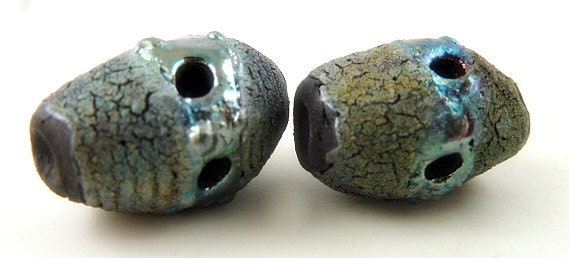
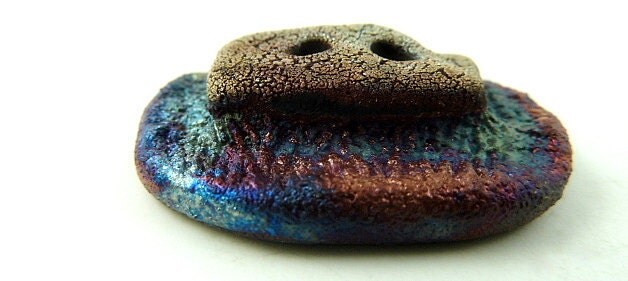
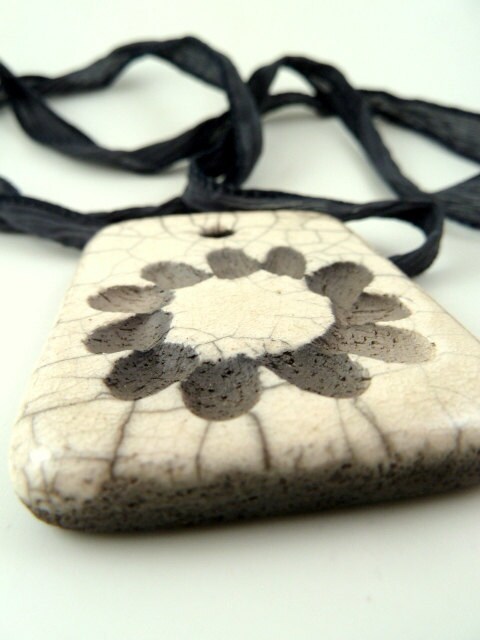
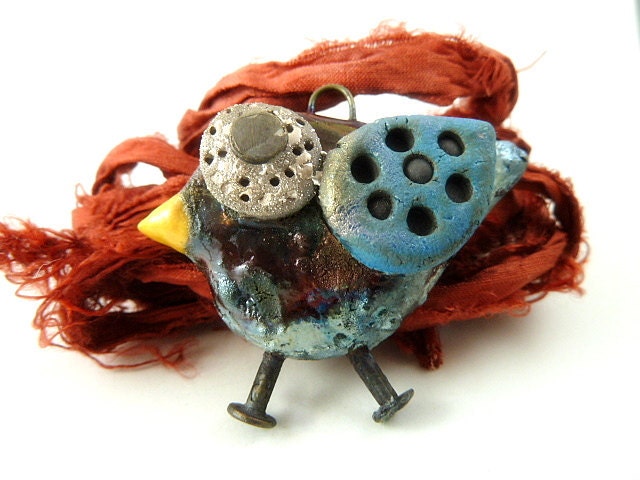
Raku: This type of kiln is usually handmade. Once the kiln (often made from high fire barrel) reaches a temperature of 1860 degrees, the piece which is red hot is placed into another barrel of straw, sawdust, and paper which ignites instantly. The barrel is quickly covered and the work remains inside for a period of time. The glaze is often known for is copper like luster, but there are also many other glazes that are common with raku such as crackle glazes.

raku beads by Elements Pottery

Pit Fired: This is sometimes confused with wood-firing. I don't really know too much about this method, but I found a great little post that you might like to read. You can get there by clicking the link under the picture.

Pit-fired beads Lil Fish Studios


Mid-fire clays: There are many types. Some prefer to use stoneware and others porcelain.  There are many colors and types of stoneware. These are personal preferences for the artist and many choose what they do for the effect that they wish to achieve. There are stoneware clays that are nearly white and some that are black. The outcome of your piece depends on the type you use. If you use browns or blacks, the outcome after glazing will be extremely different than if you use white.

You can click HERE for a great post that Marsha Neal did on mid-fire clay and glazes for the Beads of Clay blog.

Mid-fire porcelain from the few left in my almost retired Etsy Shop

High-fire clays: Again, like mid-fire, these can be either stoneware or porcelain. These clay bodies can be fired to 2400 degrees. These are often used with methods such as gas, wood, soda, and salt. The process is used to create a certain look. The added materials (soda, ash from wood and salt) mix with the glaze for various outcomes. You will not see these used much with beads for a couple of reasons. Often kilns are large and designed for larger pieces. Also, the salt, soda or wood ash lands freely on the piece. When beads are glazed and put on bead trees, many can get lost due to the free form melting that takes place.

Here is a group that was showered with ash. It was a little bit of a disappointment, but it is the price you pay when wood-firing. The ones behind that grouping that were more protected came out great, but as you can see, there is a big chance of losing many.


I could not find any examples of soda or salt fired beads, but I do have wood-fired. That's because I am married to a wood-fire artist and get to put my little beads in his very big kiln!

We are going to experiment with mid-fire porcelain this time by adding it to the way back of the kiln. Here is a picture of what is going in.  I don't think I will put all of the porcelain in until I see the results.


Obviously, they need to be glazed. The ones on the tray are mid-fire porcelain and the others are high fire stoneware. Hopefully, I will share some results that are beautiful and not like the first picture that I shared in this post!

I'm a risk taker..... so, we'll see what happens.

Here are some of my favorites from past firings. The downside of wood-firing is that it is unpredictable. The kiln gets stoked with wood from every five minutes to every one minute near the end for about 16 - 20 hours.

The upside is that you get unique, one-of-a-kind pieces with every firing like a few of my favorites that I have pictured below.


So, I hope that you have learned a little more when shopping for ceramic pieces. If you are a ceramic artist or if you have any questions, please feel free to chime in.

Thank-you for supporting artists who create handmade with handmade,

MaryAnn

Saturday, December 17, 2011

guest post - marianne kasparian


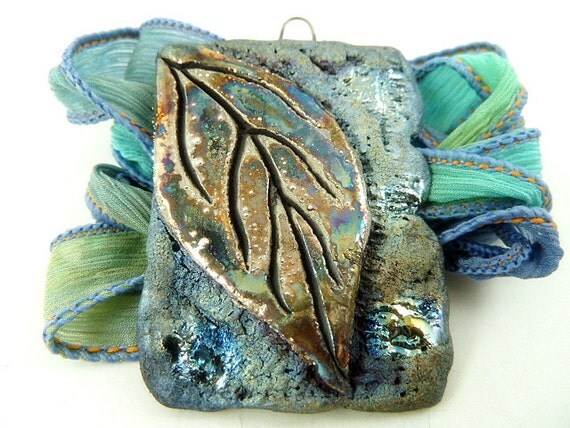
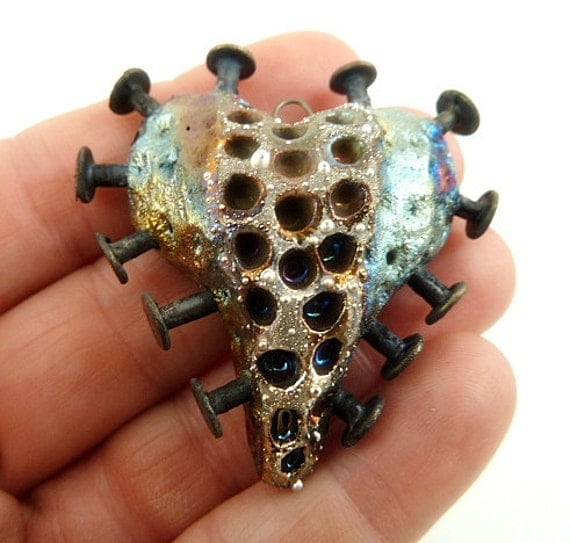
Hi there! I’m “Mak” (Marianne Kasparian) of MAKUstudio. I love raku and can truly say that I have found my passion. I remember getting a palm/psychic reading when I was younger and they told me that I wouldn’t find my career path until later in life…that I would try several things before finding the right one. I was perplexed at the time, but the wait was definitely worth it and my life experiences somehow brought me right to where I’m supposed to be. From three years of high school ceramics, design and color courses in college, a degree in Textile Marketing, taking metalsmithing after graduating when I decided I wanted to be a jeweler…to working at a bar that had 1000 beers, driving across country by myself and coming to a point in my life when I had to do much soul searching. These things all make me who I am today…a creative soul. I live to raku, and raku to live (in more ways than one). 


At all my shows, I ask my customers if they are familiar with raku. Of course, it depends on the show, but I’d say 8 out of 10 have never heard of it. So, I’d like to tell you a little bit about the firing process which I adore.


As far as the actual process of getting to my final product:
*first I create the pieces out of clay
*then let them dry and sand the pieces to make sure backs are smooth and there are no sharp protrusions of clay
*then I bisque fire them in an electric kiln to harden them and get them ready for glazing
*then I wash the pieces to get any clay dust off them so that the glazes look good on the final pieces
*then I glaze the pieces (this is the most time consuming!)
*then I raku fire the pieces in an outdoor kiln (which my husband and I built ourselves).


The raku firing involves a fast firing that goes to over 1800 degrees F (for the most part), then pulling the pieces out of the kiln while they are red hot using special gloves and tongs and placing them in a reduction chamber (small can) filled with organic materials such as newspaper, leaves or sawdust; the organic materials catch on fire and the lid is then placed on the can; the fire wants oxygen to keep going and pulls it out of the glazes themselves; smoke is created, creating the matte black look of raku wherever there is no glaze; the pieces are left in the can to cool, then removed and scrubbed clean of the ashes and voila! There are many variables which can affect the final outcome of the glaze including the weather (humidity, wind, rain, temperature), how large or small the reduction chamber is, how long I take to get from the kiln to the can, how much organic material I put in the can, what type of material is in the can, and many more. That’s why raku is truly one-of-a-kind!


I hope my creations bring you much inspiration…that is what truly inspires me.


----------------------------------------------------

you can learn more about marianne and purchase her work on
her etsy shop
her website
or her facebook page... 

thank you, marianne for sharing your work and process... 


face
Related Posts Plugin for WordPress, Blogger...