Showing posts with label ceramic beads. Show all posts

Thursday, July 24, 2014

Making Ceramic Beads with Wire Loops

When I find the time to be in the studio and work with my porcelain or chocolate stoneware clay with the intention of making beads, I put on some good music, pull out my tools and sit and hope for no interruptions (which has been quite difficult this summer with kids and a basement room renovation).
Right now I am working on some bead stock for D7 Studio and Thornburg Bead Studio for their bead shows, and Staci Louise for her class at Bead Fest Philly.
I would really love to get some up intop my Etsy shop too...
These are small textured cones I love to make, that are perfect for earrings.
I first roll out my clay, then form a cone shape, which is then textured. 
Once I work through that batch, I insert the small Nichrome wire loop that I have pre-made.
I use memory wire cutters to cut this very hard wire, and my triple step concave jaw pliers to create the "loop".
As I am making these teeny U-shaped loops - which are first cut to 3/4" (19mm) in length, then bent in half, I try to bend the ends of the wire to almost touch itself.
The wire I use is Nichrome Wire, which can withstand the high temperatures (2230 degrees F) that I fire my beads to.

I feel that when you are working with ceramic clay (or polymer clay, paper clay, and other mediums that do not fuse the metal wire to the bead such as silver wire and silver clay fuse to make one piece) it is important to have this bit of wire to cover up - see the gap in the clay where the wire was inserted in the photo below:
That clay is then immediately smoothed over with a rubber tipped detail tool to capture the ends of the wire down into the clay, where it will not wiggle loose or come right out (as it could if it were just a straight U-shape).
It is just one of those teeny extra steps that a bead maker should take to ensure that the bead is of high quality for the jewelry designer and eventual wearer of the bead.
In the photo above you can see some of the shapes of the loops as they are when first formed.
I will make the edges almost touch before putting it into the bead.
And for those people that prefer holes to wire loops, some of the shapes can be skewered by bamboo or other teeny tools.
I make sure to poke it through both sides and tap the edges down to make sure there are no pointy clay pieces that will be annoying later down the line.
They are all put into little bowls, are dried and then fired to Cone 04 or about 2000 degrees F (the bisque firing - they do not fuse together at this stage, so they can be stacked like this) to make them more durable to then paint with ceramic glaze.
The image above is the finished glaze firing load fired to cone 5 or about 2230 degrees F.
Every piece has to suspend individually as to not touch in the firing or else they will fuse together.
And when they are out, I pair them up with their mates (just the way I work - I like to work with the intention of making sets).
If they end up coming out of the glaze firing as a set, that is how I sell them.
Sometimes individuals come out too - but not too often.
One thing I really enjoy about a fresh load of glazed ceramic beads is having them all there so I can pull out other artist beads from my stash and match them up.
I am actually thinking of selling these matched sets - just simply because it is not that easy to color match through online shopping.
This will satisfy my need to shop for artist beads AND allow others to shop with confidence for beads in the same color family...
My Friend Nikki of Thornburg Bead Studio shared this image of her flower beads and my ceramic beads that she quick whipped up with a few jump rings and ear wires!

The design possibilities of using beads with loops is amazing!
Have you tried them yet?

Thursday, May 8, 2014

Components, Finished Pieces, and Growth

As a ceramic artist, gardener, and mother, there is something a bit extra special when you receive a gift of freshly picked flowers from a young child.
These flowers may be something you have been trying to grow or something that is plentiful without any effort at all. Either way, that special feeling that those were picked because that child thought of you and how you may enjoy those flowers - no matter how teeny the stem is once picked - is just beyond words...
As a ceramic bead maker, I started making some cone beads, which then changed into these larger cone shaped pieces, which I put two holes on the side so I could then hang them with wire.
I call them "Seed Pod Collectors".
Purely because of my daughter - the collector of anything in the garden...
And my good friend Jenny Davies-Reazor, a ceramic bead maker and mixed media artist was over one day for lunch, and I gave her one of these to fiddle with.
She had the brilliant idea of stuffing polymer clay into the bottom of these, adding some of my ceramic headpins and extra wire, then baking it to cure the polymer.
I love the way she added wire and a couple of spacer beads to the sides too.
And below I was creating layered porcelain beads and started putting some of the handmade glass headpins from my friend Nikki Thornburg to see if there was potential there for some fun pieces.
My brain just fluctuates between making bits and pieces - components...
Or trying to make finished pieces that could in my head, will hold special memories for that person that ends up with that pieces.

Either way, my work deep down, is never really finished when I am letting it go through selling it or by gifting it, it goes on and finds it's future path.

Right now I am getting into production mode of ceramic bead making for the Bead and Button Show in Milwaukee, WI (June 6 - 8, 2014). If you happen to be in the area for that show - make sure to stop and see me in Booth #610 with Nikki of Thornburg Bead Studio!

Thursday, April 24, 2014

Ceramic Flower Disc Beads and Organization

I love that I have my creative studio space in my house.
I dream of having a secondary building somewhere where I can run my business and hold artist retreats, but right now with young kids, it's just not something on my horizon.


I try to sneak in an hour or two of clay time a week.
I remember those days where I could work all day and night on my work, but having kids, those days are long (LONG) gone. And even though I miss it sometimes, I really enjoy where I am right now in life...


And sometimes when I work on new pieces in series, I should listen to my brain that says:
"Hey! WAIT!!! Now that these are drying in groups, you should immediately sort them into smaller bisque containers for the bisque firing NOW instead of having to sort through all of these pieces after the bisque firing!"


Did I listen to my brain?
Not at all... (kicking myself)
So I had to spend (waste) an extra 20 minutes to sort through this entire 6" x 8" container full of my new flower disc beads.
Truth be told - I think my brain ignored itself because it somehow knew that I needed that 20 minutes of extra bead fondling once these were out of the bisque firing.


Now that they are fired and sorted, when I get to the glazing point, I can easily pull out the plastic drawer (I use the ones from the hardware store that stack high and have 30-50 drawers in each) and pick pairs. 
I like to work in pairs from the glazing point. If they make it out of the kiln with a matching mate, then it was meant to be. 
If not - then well - independence is theirs!
I have some in my Etsy Shop, and will be glazing more in early May for a shop update and for stock for Bead and Button (booth #610 with Nikki Thornburg Bead Studio).
And to send to Darlene of D7Studio where she represents Marsha Neal Studio.


And I am taking a little bit of time here and there to tend to the garden and spring clean up.
I just love these Hellebores...
First time this one is really blooming!
Curious to see about the cross pollination of this double blooming head with some of the others in the garden (they take 5 years from seed to blooming mature plant).


And a little educational treat for myself...
I adore felting, and have had two opportunities to take classes with the very talented Sara Renzulli of Sarafina Fiber Art, where we have been needle felting structural creatures.
This one is the Bunny Puff Kit (she has all kinds of critters as fibers are available and restocks often).


I love these for my house, and learning about creating structural fiber work is really going to help me take the next steps towards where I want my body of work to end up...

If you have ever wanted to learn needle felting you should check out her shop and her SarafinaFiberArt You Tube channel for a bunch of tutorials.

Thursday, April 10, 2014

Cleaning Bead Holes: Fine Finishing Boot Camp

One of the most difficult things to deal with in the ceramic bead making process is the bead hole.
More specifically, keeping the glaze from filling the hole(s) and avoiding sharp edges around your bead hole.
Marsha Neal Studio Glazed Porcelain Pendants.
Almost 2 years ago I wrote up this blog post about Cleaning Your Holes!

I have had many friends ask me to clean out holes from other artist pieces or commercially made beads they bought either online or at a show, but did not realize that the hole had been fused with glaze or that it had not been cleaned.
Or that the hole was way too small for the intended use.

My previous post goes into details on using diamond tip drill bits with a Dremel tool and with water, so I won't bore you here with the same info.

Glass beads that are made on a mandrel will need to have the bead release cleaned out of the hole. The beads are usually soaked in water then drilled out.
(Check out this great post by ShebaMakeda Glass Beads)

Polymer clay bead holes can be enlarged by drilled out with a drill bit after the clay has been baked.
(Check out this cool post: Lentil Bead Drill Jig by Desiree's Misc)
Image: Beaducation.com Small Files (Set of 6)
Metal beads can usually be cleaned with a small file.
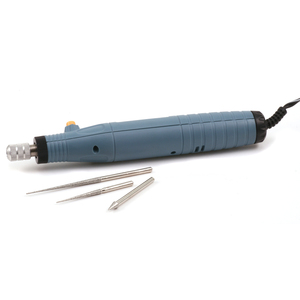
Image: Beaducation.com Pro-Electric Bead Reamer
Bead reamers of all sorts (electric and manual) are available through many bead suppliers, hardware stores, arts & craft stores, etc.
Image: Beaducation.com Diamond Bead Reamer Set

Because I work in a manner of "production" when I am cleaning out my bead holes, I prefer to use my cordless Dremel tool with a diamond tip bead reamer and a bucket of water.

And now that I saw that Dremel has a drill press - I think I know what is going to be on my next "need to get this tool" list. I have way too many gemstone beads and agates that have weird holes that are narrow on one side, wide on the other - that I need to fix!

When using bead reamers or drill bits to enlarge your bead hole,
Please remember to work SAFE and SMART by using:
Gloves, goggles, dust mask, wet drilling to reduce dust and heat, etc.
And remember to work smart with water and electricity: dip your bead and just the tip of the drill bit!

And bead makers - remember - it is up to you to sell a product that is usable and of the highest quality that you are capable of. Don't skip on quality steps like this because it will only make people pause before they purchase something else from you in the future.

Friday, March 21, 2014

All of this for Wood-Fired Beads?

MaryAnn Carroll
I must say that I am pretty lucky to be able to include beads in regular wood-firings. It is definitely a rare happening, since, who would build a 34 cubic foot kiln to fire beads in? My husband, of course. I think he does this just to keep my happy! Yes, I am SURE he does this to keep me happy!!

The truth is that there is quite a process that goes into wood-firing. The first part of the process is the same for all ceramic artists who use a wheel and fire with methods such as electric or gas. You start off with clay...... and a wheel....

Then, a few steps follow.... like skill, knowledge, artistry, practice, more practice and more practice, until you get it just right. Nothing can replace the time to perfect an art like practice.

This is Bill at a recent "throwing" event near our home.
Once the piece is thrown, it is left to dry until leather hard. At this time, the thrown piece gets trimmed.... Well, MANY pieces get trimmed. To fill his wood-fire kiln, it takes about 300-350 pieces depending on the size of the pieces.

A leather hard bowl that has been trimmed.
Now, it takes about a week or two for the piece to dry completely. At this point, they go into his electric kiln to be bisque fired. A bisque firing basically prepares a piece so that it can be handled without breaking during the glaze process.

This is one shelf prepared for a bisque firing inside of the electric kiln. Typically, 4-5 shelves similar to this are stacked.
A grouping ready to be removed for glazing.

 After they are bisque fired, it's time for the glazing....

As you see, he has a little of the female appeal going as strongly encouraged by me....


This group shows the wadding on the bottom of some pieces. I will explain that more when I post Part II of the process.


Look at the picture below. Do you see where the arrow is pointing? That is one small rack of my beads. You might be able to see why wood-fired beads are rare. These kilns are not built for beads and most who go through the labor of building a wood-fire kiln are doing so for the love of this form of pottery making, as well as for larger works of art.

Bill is preparing for another firing now. I will keep you posted for the 2nd half of the process. It's even more involved that the first half. You can learn a little more in advance by visiting his website and/or his shop.


Here are some beads from some past firings.


Thanks so much for reading and for supporting artists who create handmade with handmade.

MaryAnn


Wednesday, March 5, 2014

Ceramic Bead Quality through Chemistry

To continue on with the discussion about Ceramic Clay Beads, the one absolute thing that must happen for earth clay to become ceramic clay, is a firing of the materials to a high temperature where the materials - on a molecular level bond together. Click HERE for a great explanation of the firing process.
For the most part, ceramic artists bisque fire their wares to around 1750 degrees F so they can paint ceramic glazes on them.
Marsha Neal Studio Bisque Fired Ceramic Beads
Ceramic artists also may want to layer underglazes by brushing on and wiping off the colors in layers. This could not be achieved on greenware (unfired clay) without layers of clay being removed as well.
Jenny Davies-Reazor ceramic glaze fired pieces:
Technique: Color on, wiped off, layered more colors on, wiped off, clear coated, glaze fired.

The second firing - the glaze firing - is usually much higher, bringing the ceramic clay close to vitrification.

Sometimes ceramic artists are able to glaze their greenware pieces and do a "once firing", but it is not a frequently used technique due to high breakage of greenware while glazing.

A ceramic glaze that fits the clay body and is fired to these almost vitrification temperatures (upwards of 2200 degrees F) makes the ceramic clay quite durable. Here is a link to explain a bit about glaze and clay "fit" issues.

Glaze firing beads can be a bit tricky because the glaze will flow down the piece when it is fired in the kiln and if the glaze touches anything it will fuse to it.
Marsha Neal Studio Fused Glazed Bead Pendants that touched in the glaze firing.
Some people decide that firing their work with a non-glazed back is the way to go - this is either a decision made by artistic choice or because you are firing to a much higher temperature than the Nichrome rods can handle or maybe the community kiln you are firing work in doesn't want to spend the time to load each tiny bead by bead as it is a quite tedious thing to do.
Jenny Davies-Reazor Cone 10 Reduction Firing Pendants
Some ceramic bead makers like to suspend their work from a bead rod or nichrome wire that has been cleared of glaze (see my previous post). Nichrome rods can go up to Cone 6 firing, but will often sag under weight at those temperatures.
Marsha Neal Studio Kiln Firing - Suspended Beads and Pendants
GLAZE SAFETY: Always try to minimize the amount of ceramic clay or glaze dust you create by wet sanding or sponging your underglaze or glaze out of bead holes. Wear dust mask, goggles and gloves to protect yourself, and wet clean your area immediately after to avoid making excess dust.

NON-FIRED or COLD GLAZING on CERAMIC
What if you are working with ceramic beads and you want to use a non-fired painting (or cold glaze) technique to finish your ceramic work? Looking past the many cringing faces of traditional ceramicists - trust me - just about any serious ceramic potter or ceramic artist cringes just a bit when you talk about "painting" your ceramics and not "firing" them - that is just the way it is with the magic of fire and kilns and the interaction of the glaze material on the ceramic clay body during the firing...

If you are at point where you want to paint your ceramic clay in a non-fired finish, you want avoid it looking like a child did it without any thought or care, because that is just pretty offensive to the ceramics art community (sorry, I have to be blunt about that). You want it to be of the highest quality as possible, expressing your own personal artistic vision. Push yourself until you achieve what you are wanting to express and then stand behind your work and feel proud of your work.
In progress image of painting ceramic beads with water color paints.
Artists looking to paint their ceramic clay can use air dry, cold glaze, or heat set (think heat guns or oven temperatures) products. These include paints - oil, acrylic, water paints, pigments, dyes, colored pencils, pastels, wax, guilders paste, etc. Some of these materials work fine layered directly on bisque ceramic beads, and sometimes they need a thin layer of gauche - as they are little ceramic canvases if you think about it. Cold glaze refers to something that was air dried then sealed for protection.

Often, the time it takes to layer on, remove layers, paint more layers - letting layers dry in-between, makes a bead cost the same if not more expensive than a similarly glaze fired ceramic bead. Pricing of work like this is all about the artists time that goes into finishing that item, and to the quality of the work in question.
So no matter if you glaze fire your ceramic piece (kiln fired glaze finish) or you bisque then finish it with "non-fired" or "cold glaze" techniques, it is always important to make your best work, understand your material, make sure the surface of your ceramic work is sealed for longevity (if required) and communicate clearly what material you are using and the suggested intended use. Think about safety when intended use comes to mind, as ceramic clay edges can be sharp if they are broken, and often are not really great around young children as they tend to drop, bang, hit, throw, and eat anything they get their hands onto.

Here are a few other recent blog posts about ceramic beads if you are interested in educating yourself more about this versatile material:
Mary Harding for Art Bead Scene: Inside the Studio
Caroline Dewison for Art Jewelry Elements: The Life of a Bead
Natalie Pappas: What Makes "Ceramic Clay" Ceramic?
Lisa Peters Art: Celebrating Ceramic
Jenny Davies-Reazor: Ready. Glaze. Fire! (Cone 10 reduction firing and ceramic pendants)

And remember, we'll be updating our Love My Art Jewelry Ceramic Clay Pinterest Board with links to artist pieces, ceramic clay educational posts, tutorials, and such.
face
Related Posts Plugin for WordPress, Blogger...